Condominium Market in 2026 Continues to Slow Down, Awaiting New Government to Restore Consumer Confidence and Stimulate Economic Recovery
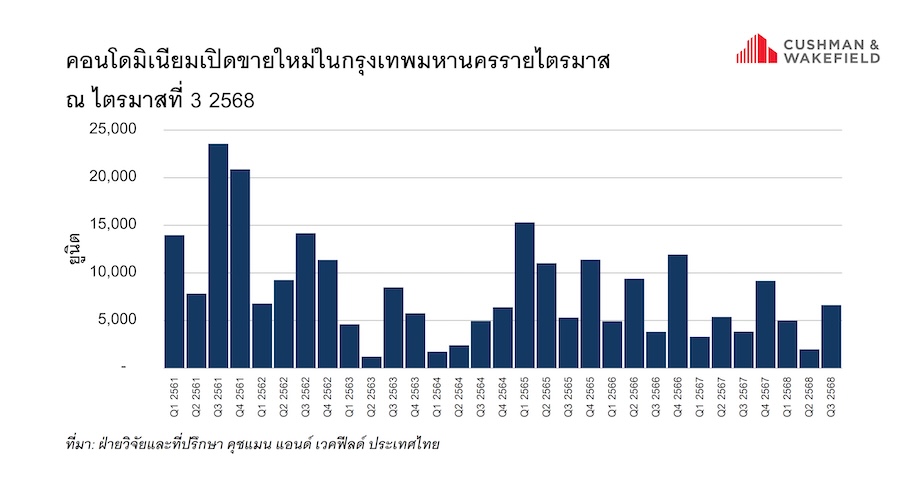
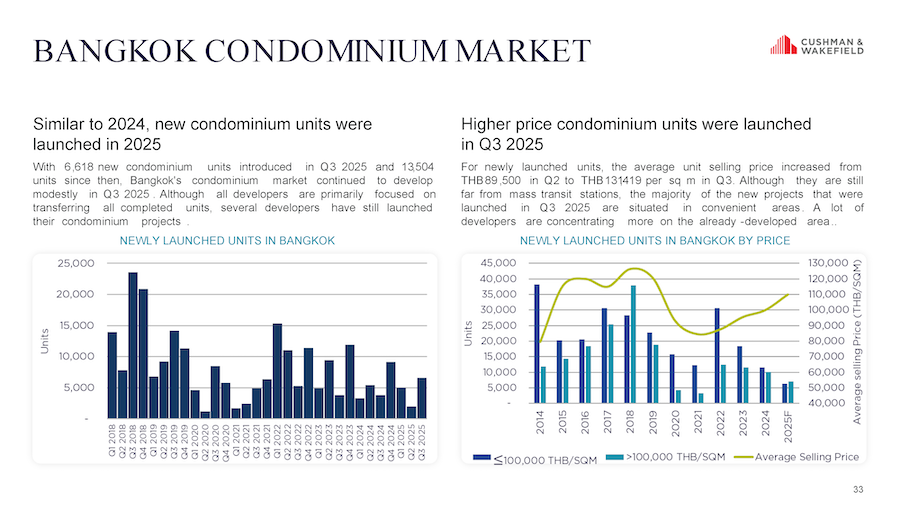
Colliers Thailand assesses the condominium situation in 2026 to be similar to that of 2025, hoping that a new government will help stimulate purchasing power and restore consumer confidence, easing the economic situation. In the third quarter of 2025, approximately 6,618 new condominium units were launched, mostly located along the BTS Green Line. It is indicated that the remaining period of 2025 will see purchasing power remain low due to economic stability, job security, and strict lending policies from financial institutions. There is hope for improved purchasing power from Chinese buyers in 2026, as Thailand continues to be the No. 1 choice for Chinese consumers looking to buy property.
Mr. Surachet Kongcheep, Head of Research and Consulting at Colliers Thailand, revealed that in the first half of 2025, there were not many new condominium projects launched. However, in the third quarter of 2025, more new condominium projects began to emerge, notably many of which are priced relatively high. In total, about 6,618 new condominium units were launched in the third quarter of 2025. Interestingly, many projects were opened for sale without an official presale announcement, allowing for some floors to be reserved first to gauge market interest before officially launching sales shortly thereafter. Additionally, several projects were launched in September, which may have affected the overall market activity in the third quarter, as there were fewer new launches in July and August. Some condominium projects have attracted more interest from general buyers and investors than others, primarily due to their location and reasonable pricing.
The new condominium projects launched in the third quarter of 2025 are mostly located along the BTS Green Line, with only 11% situated along other lines such as the Pink and Blue Lines. Developers have chosen to develop projects in areas they see potential in currently, rather than along construction lines as in the past. Consequently, the selling prices of newly launched condominiums have increased by about 47% from the previous quarter, possibly because the new condominiums launched in the second quarter of 2025 were priced lower due to their locations outside the BTS routes and in the outskirts of Bangkok. Although over 89% of the projects launched in the third quarter of 2025 are along BTS routes, most are located in alleys away from main roads and more than 1 kilometer from the nearest station, with some even further than 2 kilometers, yet they command high prices due to being in areas with relatively high land prices, such as along Sukhumvit and Charoen Krung roads.
The trend for the condominium market in Bangkok for the remainder of 2025 remains sluggish, despite new project launches in the third quarter. Several negative factors, particularly the long-term confidence of Thais in the economic situation and their job security, remain low, leading to consumer spending not differing significantly from previous periods. Additionally, the long-term debt incurred from purchasing property at this time is still not advisable. Financial institutions are also strict in their credit assessments, even though the demand for housing still exists. Therefore, renting has become a common topic of discussion and is almost a norm for young professionals just starting their careers. Some developers are attempting to assist buyers facing credit issues by providing consultations, offering rent-to-own options, and collaborating with financial institutions to help potential buyers understand the process of obtaining loans better.
Regarding the outlook for the condominium market in 2026, it is unlikely to differ significantly from 2025, as the current situation will carry over into the next year, which will be an election year. Therefore, the economic climate and investments may still need to wait for clarity. The real estate market situation in 2026 is expected to be no better than this year in terms of supply and demand for condominiums. The current government is quite clear that it cannot remain in power for long, and if there is a dissolution of parliament or events leading to a new government, confidence in investment and the stalling of various policies may occur again. Developers may wait to see the situation at the beginning of 2026. Thus, it is anticipated that if the elections or government changes proceed without issues, Thailand's economic situation may improve, boosting consumer confidence more than before. However, it is essential to closely monitor both domestic and international developments.
Mr. Surachet also commented on the purchasing power of foreign buyers, stating that accessing foreign purchasing power has been one of the strategies that developers have continuously sought to tap into. Many developers have collaborated or established joint ventures with foreign brokerage firms, particularly targeting Chinese buyers to reach foreign purchasing power directly without intermediaries. Additionally, there are brokers from other nationalities, such as Russia and Myanmar, who are working to assist developers in selling condominiums or various types of housing to their fellow nationals, especially Russians, who have garnered significant interest from developers, particularly for projects in tourist areas. Foreign purchasing power, especially from Chinese buyers, may increase in 2026 as conditions improve, and misconceptions about safety in Thailand have significantly changed for the better. Although some Chinese buyers have opted for other countries over Thailand this year, when considering the desire to purchase property, Thailand remains among the top choices or consistently ranked No. 1 in the minds of Chinese consumers, regardless of the ranking organization. However, in recent times, some Chinese buyers may have faced financial issues due to the real estate market in China not yet recovering, but it is gradually improving.